
TL;DR
The Claude Code leak didn’t just expose Anthropic’s product roadmap. It proved that the agentic orchestration layer, the part of the AI stack that most companies treat as their competitive advantage, is one packaging error away from becoming public infrastructure.
For founders: your moat is not where you think it is.
For allocators: the IP protections underpinning AI valuations are structurally weaker than anyone is pricing in.
For anyone building on frontier models: the operating environment just got a threat briefing that demands attention.
Introduction
Anthropic just accidentally published its entire autonomous agent roadmap. Not the model, not the weights. The roadmap: 44 unreleased features, internal benchmarks, and the full architecture for a system that runs without human input, consolidates its own memory overnight, and decides when to act on your behalf. All of it shipped to the public npm registry because someone forgot to exclude a debug file.
This is a company suing the Pentagon.
Three weeks ago, a federal judge blocked the Defense Department’s attempt to designate Anthropic a “supply chain risk” after its CEO refused to let Claude be used for mass surveillance or fully autonomous weapons. The judge’s exact words: “Nothing in the governing statute supports the Orwellian notion that an American company may be branded a potential adversary and saboteur of the U.S. for expressing disagreement with the government.” That company, generating US$19B a year and preparing a US$60B+ IPO, just handed its competitors a 512,000-line blueprint for autonomous AI agents because of a config file.
On the same day, OpenAI closed a US$122B funding round. SoftBank’s share was backed by a US$40B unsecured bridge loan, which tells you they’re betting on an IPO liquidity event within twelve months to pay it back. Two companies locked in an existential race for capital and credibility: one just published its product roadmap by accident while the other was printing the largest private funding round in history.
The embarrassment fades fast. What lasts is what the exposed architecture tells us about where every AI system is heading, and why the usual assumptions about competitive moats just got tested against reality.
All This Has Happened Before
In 1982, IBM’s sole proprietary advantage in personal computers was the BIOS firmware. They were so confident it couldn’t be replicated that they published the source code in the back of their own technical manuals, banking on the legal principle that anyone who read it would be “contaminated.”
Compaq and Phoenix Technologies proved them wrong. Clean-room reverse engineering: one team wrote functional specifications describing what the code did; a second team, who had never seen the original, built a new version from those specs. Phoenix assigned it to an engineer whose entire background was in TMS9900 processors. He’d never touched x86. By 1985, clones were flooding the market at half of IBM’s price with better specs. The moat vanished in roughly eighteen months.
The durable advantages in the PC era turned out to be in completely different layers of the stack. Intel owned the silicon; Microsoft owned the operating system. The firmware that IBM thought was proprietary became a commodity input.
Anthropic’s agentic orchestration layer is now going through the same transition. Clean-room reimplementations in Python and Rust appeared within hours of the leak; they’re open-source and model-agnostic. The question is no longer whether this layer commoditises. It’s where the real advantage sits now that it has.
What the Code Reveals
The most significant thing in the leak is called KAIROS. Named after the Greek concept of the opportune moment, it’s an unreleased autonomous daemon that transforms Claude Code from a tool you interact with into a system that runs persistently in the background. It receives a tick prompt every few minutes, decides whether to act or stay quiet, and defers anything that would interrupt you for more than fifteen seconds.
Its companion feature, autoDream, runs memory consolidation while you’re idle. A forked subagent merges observations, removes contradictions, and converts vague insights into structured facts. It runs in a separate process so that maintenance routines can’t corrupt the main agent’s reasoning. This is computational sleep: the system organises what it learned during the day so it starts fresh with a cleaner context.
Underneath both sits a memory architecture that solves a problem every AI builder recognises. A lightweight pointer index stays permanently loaded, telling the agent what it knows and where to find it. Knowledge gets fetched on demand from the file system, never stored in working memory. And the agent can only update its own memory after a confirmed successful action, preventing failed attempts from polluting context. The system treats its own memory as a hint and verifies against ground truth before doing anything.
The deeper insight is about forgetting. Keeping a long-running autonomous system reliable over time requires aggressive curation; the value is in what the agent discards, not what it accumulates.
Psst… Agna is building something in stealth: an AI-native decision intelligence platform for DeepTech capital markets, designed around the thesis that the only non-replicable asset in this entire space is the compounding behavioural record of how expert practitioners actually make high-stakes investment decisions. We started from the same structural assumptions that the leaked code confirms: that model intelligence commoditises fast, that orchestration patterns converge across the industry, and that the layer worth building is the one that captures the delta between what an AI recommends and what a human with twenty years of pattern recognition actually decides. The leak confirmed the bet.
The Operating Environment
Most commentary about the leak focuses on the code. Almost nobody is discussing the five-week sequence it sits inside.
- February 27: The Trump administration orders federal agencies to stop using Anthropic. The Pentagon designates the company a supply chain risk.
- March 9: Anthropic files two federal lawsuits alleging retaliation.
- March 19-27: Cascading supply chain attacks compromise four major developer tools.
- March 26: A CMS misconfiguration exposes roughly 3,000 internal Anthropic assets, including documentation for an unreleased model; the same day, a federal judge blocks the Pentagon designation.
- March 31: The source code leaks. During the same three-hour window, North Korea’s Lazarus Group compromises the axios npm package, injecting a Remote Access Trojan into two versions of one of the most widely used JavaScript libraries in the world. Same day, OpenAI closes its round.
We’re not claiming causation. But the convergence of these events during a period of maximum competitive intensity creates conditions that anyone building an AI company needs to price into their risk models. In January, a former Google engineer became the first person convicted on AI espionage charges after stealing chip designs for PRC-affiliated companies. Anthropic itself documented the first known large-scale cyberattack executed primarily by an AI agent last November. The registries that underpin virtually every AI development workflow, npm and PyPI, are now documented vectors for state-sponsored espionage.
If your deployment pipeline can be compromised through a single maintainer credential, you have a single point of failure that could expose your IP, your customers, or both.
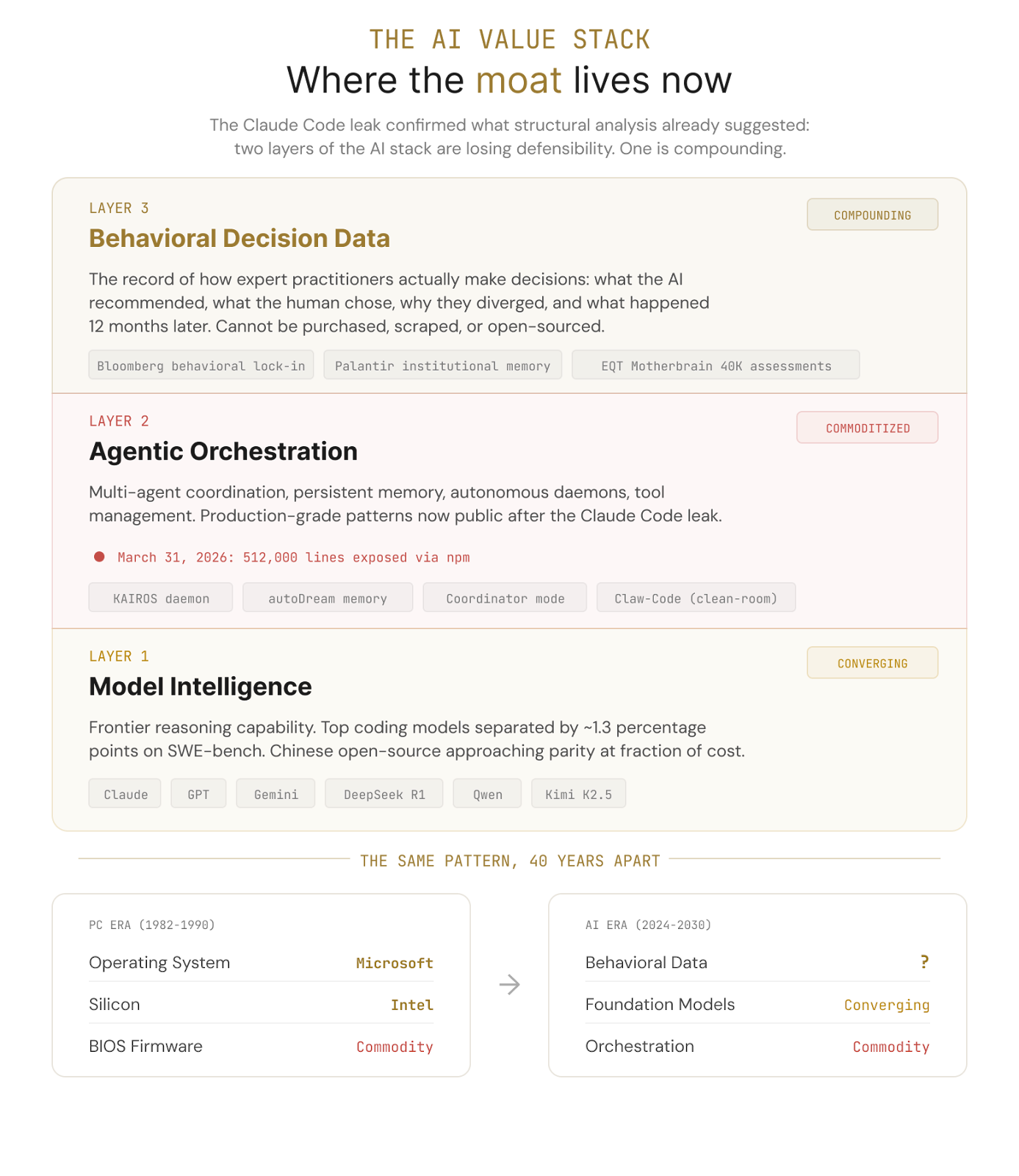
Where the Moat Actually Lives
If the orchestration layer is public infrastructure and model performance is converging across labs, where does defensibility reside?
- Bloomberg Terminal has survived every wave of data disruption for decades. Not because of better data, but because a single data point gets used simultaneously by traders, CFOs, lawyers, regulators, and researchers, each on different compliance timelines. Replacing it requires multi-party coordination, not better analytics.
- Palantir encodes client organisations’ internal heuristics directly into the platform; the software and the institution co-evolve, and removing it means rebuilding institutional memory.
- EQT’s Motherbrain has accumulated over 40,000 deal assessments in a reinforcement loop that they’ve published peer-reviewed research on.
- Zillow had an enormous data advantage and lost US$421M in a single quarter when generalised algorithms couldn’t handle local dynamics.
The pattern across all four: data compounds into a moat only when captured through a specific workflow and continuously fed back into a specific operational process. KAIROS and autoDream are excellent engineering. Everyone has access to that engineering now.
The Copyright Trap
Dario Amodei has publicly stated that 70 to 90 percent of the code at Anthropic is written by Claude. The D.C. Circuit ruled unanimously in Thaler v. Perlmutter that copyright requires human authorship; the Supreme Court declined to review.
After the leak, Anthropic filed over 8,100 DMCA takedowns, each of which requires asserting under penalty of perjury that you own the copyright to the material. If the vast majority of the codebase was machine-generated, the legal basis for those assertions is an open question under current precedent.
The paradox runs deeper. In June 2025, federal courts ruled that ingesting copyrighted works to train LLMs is “exceedingly transformative” fair use. Anthropic relied on this reasoning to defend its own training practices. But the clean-room reimplementors did exactly what Anthropic does: studied existing work, extracted functional patterns, and rebuilt from scratch in a different language. If pattern extraction from human-authored books is fair use, pattern extraction from a substantially AI-authored codebase should be at least as protected. Every AI company using its own models to generate significant portions of its code faces this same structural vulnerability.
What Founders Should Do With This
Stop treating proprietary orchestration as a moat. The patterns for persistent agents, memory consolidation, multi-agent coordination, and tool management are public infrastructure. Build on them instead of rebuilding them. Every hour spent reimplementing context management is an hour not spent on the part of your product that creates actual switching costs.
When Facebook open-sourced React, it killed framework startups and created a multi-hundred-billion-dollar application economy. That’s where agentic architecture sits now.
Audit your IP exposure. How much of your codebase was generated by AI? If you don’t know, you’re carrying legal risk you haven’t quantified. The copyright framework for AI-generated code is trending toward weaker protections. Build your defensibility in behavioural data from specific workflows, deep operational integration, and domain expertise that open-source replication can’t reach.
Take supply chain security seriously as a survival issue. On the same day Anthropic’s code leaked, a state-sponsored actor compromised one of the most popular packages in the JavaScript ecosystem. OWASP published its first Top 10 for Agentic Applications this year. The U.S. Treasury released 230 control objectives for financial services AI. These are responses to what just played out in public.
The structural shift is clear. Intelligence is converging; orchestration is commoditising. The value migrates to whoever captures the behavioural data generated when real practitioners use AI to make consequential decisions in specific domains, and compounds it in a way that no open-source release can replicate.
Build there.