

Listen to this Museletter
Introduction
For most of modern history, security was anchored to geography, land borders, sea lanes, and airspace, which defined how nations projected strength and defended sovereignty. That foundation is quietly dissolving. Strategic advantage is migrating upward into orbit, where constellations, compute, and communications increasingly determine whether nations command events or react to them. Space is no longer symbolic or experimental; it is becoming the operating system of national security.
As launch economics collapse and orbital infrastructure scales, defence is shifting from preventing loss to sustaining capability. The result is a new era where endurance, not dominance, determines strategic power.
Agna Insights
Space as the Re-Emerging National Security Frontier
National Security is increasingly defined by speed rather than just scale. More precisely, it is increasingly defined by endurance under compressed decision timelines rather than by episodic displays of force.
Modern defence systems operate inside compressed decision windows where minutes determine outcomes. Intelligence collection, threat detection, targeting, and coordination now depend on continuous access to space-based capabilities rather than episodic support.
By January 2026, Earth orbit underpins missile warning, precision navigation, secure communications, persistent surveillance, and integrated command systems. These functions no longer sit at the margins of defence planning. They shape its centre.
Space is becoming the infrastructure layer of geopolitical power.
The shift is measurable. Defence budgets across major powers show sustained growth in space-specific allocations since 2022. Launch cadence, constellation resilience, and ground infrastructure density are now tracked as indicators of national readiness. Space forces are integrated into joint commands rather than treated as specialist units.
This shift is no longer only doctrinal. It is increasingly reflected in fiscal planning and procurement behaviour, where space and defence allocations tilt toward continuity, resilience, and capital build-out rather than one-off demonstrations.
Civilian dependency amplifies the risk. Financial settlement relies on satellite timing. Energy grids depend on synchronised signals. Aviation, shipping, and emergency services require uninterrupted positioning and connectivity. When orbital services degrade, domestic systems fail in sequence rather than isolation.
Strategic Synthesis
Space disruption is no longer a downstream consequence of conflict. It is becoming an initiating condition.
Space is not becoming important because it is new. It is becoming decisive because it has become indispensable.
Sovereignty Migrating Beyond Territory
Sovereignty was historically enforced through physical control.
States defended borders on land, controlled sea lanes through naval power, and regulated airspace to manage escalation. Authority was exercised through exclusion and denial.
Space does not permit this model. Under international law, orbit remains non-sovereign. No state can claim territory beyond Earth. Yet strategic power is now exercised through orbital systems in ways that closely resemble sovereignty in practice.
By early 2026, orbital scale itself has become a structural advantage. Public satellite-tracking data indicates approximately 14,500 active satellites in orbit as of late January 2026, including roughly 9,500 active Starlink satellites, meaning a single commercial constellation represents a dominant share of active spacecraft in the operational layer. Counts vary by definition and update continuously, but the directional imbalance is unmistakable.
Market Signal: Orbital Scale Is Already Concentrating
This is why sovereignty in space is no longer primarily about flags or ownership. It is about who controls the tasking-to-decision loop at industrial scale.
Control now operates through dependence rather than ownership. States with resilient, sovereign, or tightly aligned space infrastructure retain decision autonomy. States reliant on foreign assets inherit latency, exposure, and constraint.
The operational mechanism is increasingly measurable. Sovereignty in orbit concentrates in five control points: (1) tasking priority and revisit control, (2) secure downlink and ground-station access, (3) encryption keys and protected communications pathways, (4) analytics pipelines and dissemination authority, and (5) assured replenishment cadence when systems degrade.
If any of these layers are external, autonomy becomes conditional. Even if imagery or connectivity exists, the right to decide “when”, “what”, and “to whom” becomes constrained.
The implications are operational rather than symbolic. Delayed imagery narrows response windows. Disrupted communications fragment command chains. Degraded navigation erodes precision across military and civilian systems alike. No territory is seized, yet leverage is immediate.
India’s Earth Observation Public–Private Partnership (EOPPP) reflects this shift. Rather than treating satellites as discrete assets, the programme is designed around sovereign control of tasking, latency, analytics, and dissemination within national decision timelines.
In August 2025, IN-SPACe awarded the EO-PPP contract to a Pixxel-led consortium (with Dhruva Space, SatSure, and PierSight) to deploy a 12-satellite constellation, with over ₹1,200 crore (~US$ 140–145 million) committed over ~4–5 years.
The strategic value lies not in satellite count, but in retaining domestic authority over how and when data is generated, processed, and acted upon, including under contested or degraded conditions.
China pursues a parallel logic through state-owned constellations and counter-space capabilities. Russia emphasises selective disruption to manage escalation without sustained orbital dominance. Each approach differs in execution, but not in premise.
Sovereignty has not disappeared. It has relocated into the infrastructure that governs visibility, connectivity, decision authority, and replenishment.
It now resides in who controls the loop between observation and action, and who can refresh that loop at pace when adversaries attempt to disrupt it.
National Security Moving into Orbit
Space is no longer a supporting layer for defence planning. It has become a primary operating domain.
Modern military operations assume uninterrupted access to space-based intelligence, positioning, navigation, and communications. These systems are embedded across missile defence, strategic deterrence, force mobilisation, and conventional operations. They are no longer optional enablers. They are structural dependencies.
By 2026, defence planners across major powers treat orbital disruption as a direct domestic security risk. Missile warning depends on persistent space-based sensing. Secure command and control relies on satellite communications hardened against interference. Precision strike, mobility, and logistics degrade rapidly without assured navigation and timing.
This dependence is measurable. As of early 2026, the United States allocates approximately US$35–38 billion annually across military space programmes, spanning launch, missile warning, tracking layers, protected communications, and space situational awareness. A growing share of this spend is tied to architectures explicitly designed for resilience and continuity, rather than single-system performance. This shift is operationalised through programmes such as the Space Development Agency’s Proliferated Warfighter Space Architecture, which deploys layered LEO constellations for missile warning, tracking, and transport with planned refresh cycles rather than single-point persistence.
Civilian infrastructure deepens this exposure. Power transmission, financial clearing, aviation safety, and emergency coordination draw from the same orbital layer. A single regional GNSS disruption now propagates across airspace management, logistics, emergency response, and financial systems within hours, not days, collapsing the distinction between military vulnerability and domestic risk.
Market Signal: Space Connectivity Is Becoming Sovereign Infrastructure
Europe’s investment in EU-controlled secure satellite communications through GOVSATCOM and IRIS² reflects this recognition, framing space connectivity as sovereign infrastructure rather than commercial convenience.
As sensing proliferates, a second dependency becomes visible: compute.
Reliance on terrestrial processing and ground links introduces latency, fragility, and escalation risk in contested scenarios. The ability to process, filter, and prioritise data closer to orbit increasingly determines whether space-based systems function as real-time enablers or delayed inputs. Missile warning, ISR fusion, autonomous tasking, and continuity of command depend not only on access to space-derived data, but on how quickly decisions can be made when links are degraded or denied.
This logic is now driving early-stage efforts to place data-centre-like compute infrastructure in orbit.
In the United States, companies such as Axiom Space are demonstrating on-orbit data-processing modules aboard the ISS as precursors to future space-based compute infrastructure. Startups such as Starcloud (formerly Lumen Orbit) are developing orbital data-centre concepts optimised for AI and high-performance compute. In parallel, SpaceX has filed with the FCC for a large-scale orbital “data-center satellite” concept, signalling institutional interest in treating compute location as part of resilience planning, even as feasibility remains uncertain.
China is pursuing a more state-directed version of the same idea. The China Aerospace Science and Technology Corporation (CASC) has outlined plans for space-based digital-intelligence infrastructure, explicitly framed as orbital data-centre capability integrating sensing, compute, and energy to process Earth-origin data in space. Public details remain high-level, but the strategic intent is clear: reduce reliance on vulnerable terrestrial data centres and ground links for time-critical workloads.
This convergence has altered escalation dynamics. Space disruption is no longer a downstream consequence of conflict. It is an initiating condition.
The opening hours of the Ukraine conflict made this explicit. On 24 February 2022, a cyberattack on the KA-SAT satellite network disrupted broadband connectivity across Ukraine and parts of Europe, affecting thousands of terminals and demonstrating how space-based infrastructure can be targeted at the outset of conflict to shape the battlespace. In parallel, persistent GNSS jamming and spoofing documented across regions such as the Black Sea show that navigation disruption is now treated as an operational tool rather than an edge case.
Major powers are responding accordingly. China is expanding early-warning satellites, Beidou navigation resilience, Earth-observation constellations, and counter-space capabilities as part of its military–civil fusion strategy. Russia maintains a smaller footprint but is investing selectively in disruption-oriented capabilities, including non-kinetic interference and proximity operations, designed to impose uncertainty and complicate adversary reliance on space rather than sustain permanent orbital dominance.
India’s posture differs in tone but not in logic. Space capabilities are increasingly treated as national infrastructure, supporting security, governance, and resilience. India’s 2026–27 Union Budget increased the Department of Space allocation to ₹13,705 crore (~US$1.65–1.7 billion), with a clear tilt toward capital expenditure, alongside a defence allocation of ~₹7.84 lakh crore (~US$94–95 billion). Initiatives such as NavIC expansion and public–private Earth-observation frameworks reinforce a continuity-first approach focused on assured access and sovereign control of data and tasking, rather than overt weaponisation.
Once a domain becomes indispensable to both military operations and civilian continuity, it becomes contested by default. Space has crossed that threshold.
Constraint Collapse as a Defence Inflection Point
The transformation of space defence is driven less by ideology than by economics. This is the rupture that makes the strategic shift unavoidable.
For decades, orbital systems were scarce, expensive, and effectively irreplaceable. A single satellite could cost over a billion dollars, require years to build, and depend on bespoke launch schedules. Failure carried strategic consequences because recovery was slow or impossible.
That constraint has collapsed.
By January 2026, average launch costs to low Earth orbit for small and medium payloads are more than 90 percent lower than early-2000s benchmarks. Small satellite production cycles have compressed from multi-year timelines to roughly 6–18 months. Commercial providers routinely deliver satellites at unit costs below one million dollars. Reusability and competitive launch markets have turned access to orbit into a throughput challenge rather than a bottleneck.
Market Signal: Launch Is Becoming A Supply Chain
This shift alters defence logic. Military architectures are shaped by the cost of failure, not the promise of success. When replacement becomes feasible, loss becomes tolerable. Systems are deployed with the expectation of degradation rather than permanence.
Defence agencies now design constellations that assume attrition. Space-based sensor networks and interceptor concepts factor in loss rates and replacement cadence as baseline parameters. Feasibility increasingly depends less on individual system performance than on industrial capacity to replenish assets fast enough.
What makes this transition durable is not technology alone, but industrial momentum. Proliferated architectures assume continuous manufacturing, replenishment, and launch cadence. Once these supply chains are established, defence capability becomes tied to sustained industrial throughput rather than episodic procurement, making reversal economically and politically costly.
This is the inflection point. Space defence transitions from protecting assets at all costs to sustaining capability over time.
When “Star Wars” Becomes an Engineering Question Again
Space-based missile defence is not a new idea.
In the 1980s, President Reagan’s Strategic Defense Initiative explored space-based interceptors as part of a layered architecture intended to defeat Soviet intercontinental ballistic missiles (ICBMs). Concepts such as Brilliant Pebbles envisioned large constellations of small, autonomous kinetic interceptors operating in low Earth orbit (LEO).
The decisive limitation was not strategic logic. It was feasibility.
Guidance accuracy, onboard compute, sensor fusion, autonomy, manufacturing cadence, and launch economics imposed hard constraints. Cost projections escalated into the hundreds of billions of dollars, replenishment timelines stretched into years, and system fragility made sustained operation implausible.
Those constraints have shifted cumulatively over the past two decades.
Advances in compute density, sensor fusion, autonomy, manufacturing standardisation, and access-to-orbit throughput have reopened a design space that was previously closed. What once failed because it could not be built, launched, replenished, and sustained at scale can now be evaluated as an engineering and industrial problem rather than a purely conceptual one.
This does not make such architectures desirable, stabilising, or inevitable.
It makes them non-dismissable.
Once a capability crosses the boundary from speculative design to engineering plausibility, defence institutions are compelled to plan for its existence. The central question shifts from whether it should exist to how it would behave under degradation, attrition, and escalation pressure.
The question is no longer whether such architectures can exist.
The question is who industrialises them first.
That shift is now visible in institutional planning. The United States is actively reassessing space-enabled missile defence as part of a broader move toward layered, continuously operating homeland defence architectures. Concepts such as the Golden Dome initiative frame missile defence not as a terminal or episodic function, but as an integrated space-ground system spanning sensing, tracking, fire control, and potential interception.
While no deployed space-based interceptor constellation exists today, modelling, funding lines, and architectural studies have moved such concepts out of the purely theoretical domain. The emphasis is no longer on exquisite survivability of individual platforms, but on whether interception functions can be embedded within orbital architectures designed for persistence, replenishment, and graceful degradation.
China is pursuing a parallel logic through expansion of early-warning satellites, midcourse tracking layers, and counter-space capabilities. Russia is prioritising selective disruption intended to undermine adversary reliance on space-enabled defence rather than replicate it symmetrically.
This marks a structural shift. Space-based missile defence is no longer being debated primarily as a question of principle.
It is being examined as a problem of engineering feasibility, industrial capacity, and escalation management.
From Symbolic Defence to Operational Defence
Early military space programmes were designed to be seen.
Satellites signalled technological sophistication and strategic reach. Their value lay as much in political messaging as in operational output. Systems were few, expensive, and treated as strategic assets whose loss would carry diplomatic weight.
That logic no longer holds.
As space systems become structurally embedded in daily military operations, defence planners increasingly treat orbit as a continuously operating layer of the battlespace. Capabilities are expected to function across competition, crisis, and conflict. Interference is assumed. Degradation is planned for. Replacement is scheduled rather than improvised.
This shift is visible in procurement behaviour. Proliferated low Earth orbit architectures now plan for hundreds of satellites delivering persistent coverage, rather than a handful of exquisite platforms. Budgets increasingly incorporate routine replenishment and refresh cycles. Platform lifetimes are shortened in favour of serviceability, modular upgrades, and rapid replacement.
Success is no longer measured by technical novelty or isolated demonstrations. It is measured by uptime, coverage persistence, and continuity of mission output under pressure.
Missile warning, tracking, and command systems illustrate this clearly. Performance is evaluated at the network level, not the satellite level. Individual asset loss is tolerated so long as system-level functionality persists.
This recalibration alters deterrence dynamics. When systems are designed to absorb loss, the destruction of individual assets no longer signals decisive intent. Escalation becomes incremental and ambiguous rather than binary.
Defence in orbit has therefore moved from exhibition to execution.
What matters is no longer whether a capability can be shown to work once, but whether it continues to function when contested, degraded, and attacked. Persistence, not perfection, becomes the strategic currency.
Perfection Losing Its Strategic Premium
Legacy space systems were built around a single premise:they must not fail.
That assumption was rational when satellites were rare, expensive, and slow to replace. Failure implied strategic shock because recovery timelines stretched into years. Engineering perfection became a security requirement. Survivability was pursued through hardening, redundancy at the component level, and bespoke design.
That logic is now misaligned with the operating environment.
As launch access becomes repeatable and manufacturing cycles compress, defence value shifts away from flawless assets toward resilient systems. A platform that is cheaper, faster to build, and easier to replace can outperform a technically superior system once attrition is assumed.
This is not primarily a cost trade-off. It is a strategic recalibration.
Analytical models of proliferated space architectures consistently show diminishing returns from incremental increases in platform sophistication beyond a threshold. Detection accuracy, interceptor effectiveness, and survivability improve marginally with refinement, but materially with scale, redundancy, and networked fusion. Numbers now dominate optimisation.
Defence institutions are responding accordingly. Constellations are increasingly designed with standardised components, shorter design lives, and modular upgrade paths. Replacement is treated as a planning parameter rather than an operational failure. Performance is evaluated at the system level, not the platform level.
This reshapes deterrence logic. When assets are replaceable, their loss carries less escalatory weight. Destroying a satellite no longer signals decisive intent. It becomes part of sustained competition rather than a trigger for immediate retaliation.
Perfection once stabilised deterrence by making loss unacceptable. In orbit, resilience stabilises deterrence by making recovery unavoidable.
Attrition is replacing perfection as the design principle of security.
Defence Architectures Designed for Attrition
Loss in orbit is no longer treated as an anomaly. It is assumed.
Defence planning now models degradation, interference, and destruction as normal features of competition. Jamming, cyber intrusion, dazzling, and kinetic attacks are treated as plausible across peacetime rivalry, crisis escalation, and conflict short of war.
This represents a doctrinal break. Earlier architectures treated redundancy as inefficiency. Contemporary systems treat redundancy as operational necessity. Capability is distributed across hundreds of nodes. No single satellite is mission-critical. Data is fused across platforms. Command systems reroute dynamically around damage.
The result is graceful degradation rather than catastrophic failure.
Missile defence and space-based sensing illustrate this shift clearly. Survivability depends less on the performance of individual sensors or interceptors than on replenishment speed and network resilience. The decisive variable is whether replacement outpaces removal.
Defence therefore becomes a pacing problem rather than a binary outcome. This has direct implications for escalation dynamics. The loss of a satellite no longer carries the signalling weight of losing a base, aircraft, or vessel.
Competition in space becomes continuous, probabilistic, and ambiguous rather than episodic and decisive.
Attrition is no longer synonymous with failure. It is the operating condition.
Country-Specific Defence Postures in Space
There is no single model for space security.
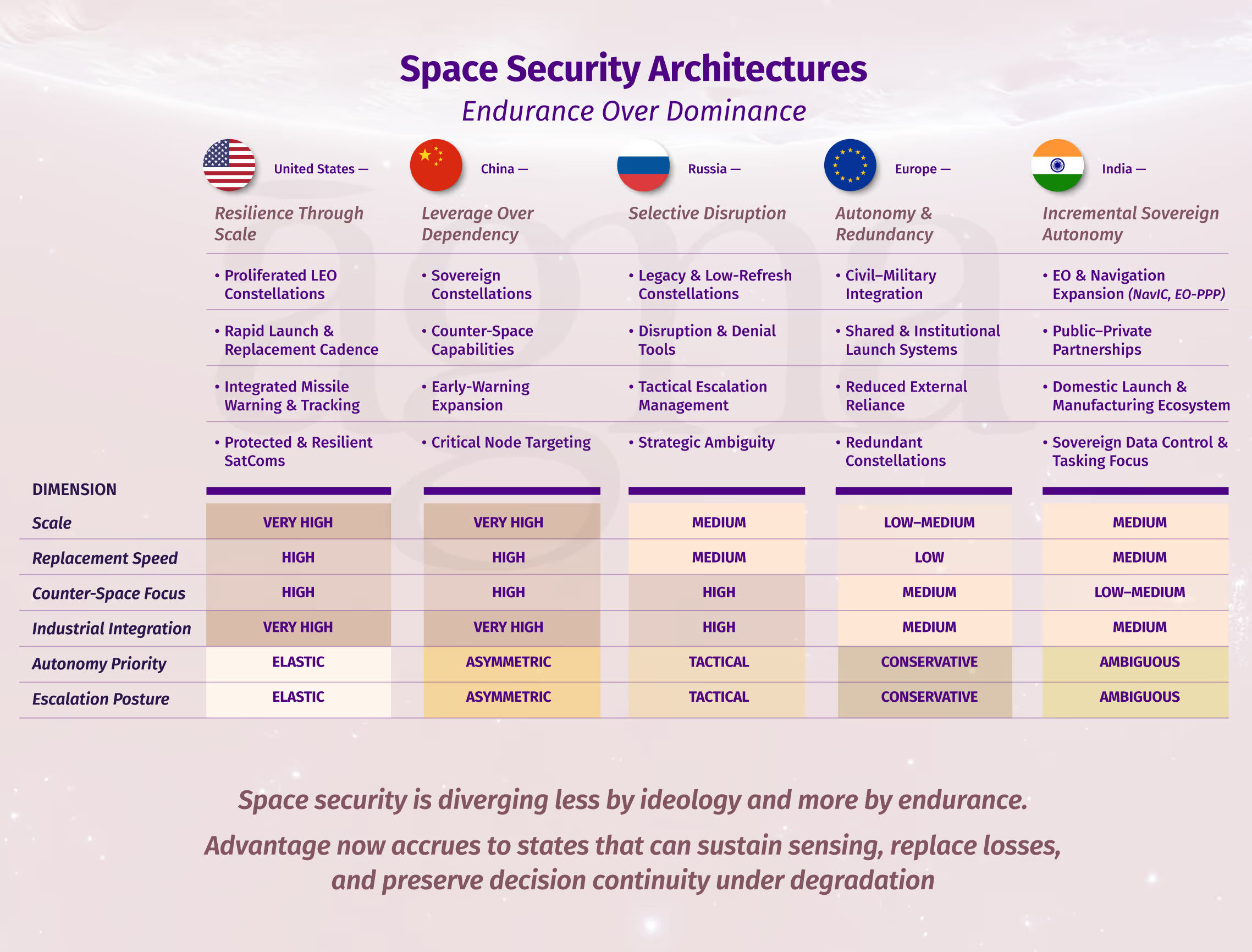
National postures are diverging according to industrial depth, threat perception, alliance structure, and tolerance for escalation. These differences are structural rather than ideological, rooted in unequal capacity to sustain loss, replenish systems, and maintain decision continuity.
The United States is prioritising resilience through scale. Its approach is centring on proliferated constellations, rapid launch, and integration across land, sea, air, cyber, and space domains. Space is being embedded within integrated deterrence rather than treated as a discrete theatre. The objective is continuity under pressure, not dominance through denial alone. High launch cadence, deep supplier ecosystems, and replenishment capacity allow attrition to be absorbed without strategic disruption. This resilience-through-scale logic is increasingly extending to missile defence, where initiatives such as the U.S. “Golden Dome” programme are examining space-based sensing, tracking, and prospective interception as components of continuously operating, space-integrated architectures, rather than as discrete terminal systems.
China is focusing on leverage over dependency. Investments emphasise counter-space capabilities alongside sovereign navigation, early-warning, and Earth-observation constellations. Rather than matching scale symmetrically, the strategy targets critical nodes, command links, and data flows, seeking to impose asymmetric cost by exploiting reliance.
Russia is adopting a selective posture. Space investments prioritise signalling and disruption tools designed to complicate adversary planning rather than sustain permanent orbital control. Persistence matters less than the ability to create uncertainty at critical moments.
Europe is concentrating on autonomy and redundancy. Limited launch cadence and fragmented industrial bases push programmes toward civil–military integration and shared infrastructure. Endurance is sought through redundancy and partnerships rather than scale.
India is maintaining a restrained but deliberate approach. Investments focus on navigation, surveillance, Earth observation, and launch reliability while avoiding overt weaponisation. Capability develops incrementally, balancing deterrence with strategic ambiguity. The emphasis remains on sovereign control of data, tasking, and decision timelines rather than visible force projection.
Emerging space powers optimise for reliability over scale. Constrained throughput favours fewer hardened systems and partnerships instead of attritional doctrines. Participation expands, but endurance remains uneven.
What differentiates these approaches is not intent, but endurance.
Space security will not converge into a single equilibrium. It will stratify.
Ambiguity Becoming a Security Feature
As space systems become more redundant and replaceable, intent becomes harder to interpret.
The loss of a satellite no longer carries a clear political signal. Failures may result from debris, interference, cyber intrusion, malfunction, or deliberate action. When architectures are designed to tolerate loss, the meaning of loss itself changes.
This reshapes deterrence. Escalation is no longer triggered by single events. Responses are calibrated over time, across patterns rather than incidents. Posture, persistence, and recovery capacity matter more than declared red lines.
Traditional deterrence relied on clarity: attribution, thresholds, retaliation. In orbit, that clarity is eroding by design. Architectures built for endurance absorb pressure without forcing immediate response.
This is often described as destabilising. In practice, it may be stabilising in a different way. When individual losses are survivable, pressure can be applied without compelling rapid escalation. Competition becomes continuous rather than catastrophic.
Ambiguity is no longer a flaw in the system. It is an operating condition of security in an environment built around resilience rather than inviolability.
What This Ultimately Argues
This is not a story about rockets, exploration, or prestige. It is a story about abundance and its consequences.
When access to orbit becomes repeatable, replaceable, and scalable, national security reorganises around endurance rather than exception. Sovereignty migrates without treaties changing. Deterrence adapts without doctrine being rewritten.
Space becomes the new high ground not because it is novel, but because it can now be occupied, defended, and replenished at scale.
Earth observation sits at the centre of this shift, not because imagery is scarce, but because tasking priority, latency, analytics, and delivery determine who decides first and who reacts second. Data access matters less than decision authority.
As sensing proliferates and systems become more replaceable, advantage no longer flows from presence alone. It flows from the ability to sustain sensing, process information under degradation, and act faster than disruption propagates. Compute, whether on the ground or progressively closer to orbit, is becoming inseparable from sovereignty itself.
States that integrate space infrastructure with downstream intelligence and decision systems gain strategic autonomy without territorial expansion. States that remain dependent inherit constraint without visible loss.
Sovereignty is migrating from territory to decision speed.
The strategic transition is already underway. It does not announce itself through conflict.
It reveals itself through resilience.Orbit is no longer above geopolitics. It is where geopolitical advantage is quietly accumulated, sustained, and exercised.
Listen to this Museletter
Questions? Feedback? Different perspective?
We invite you to engage with us and collaborate.
Warm Regards,
Team Agna
Click below to join our mailing list for The Agna Museletter.
Agna Capital Limited is regulated by the Dubai Financial Services Authority